Which One is Right for Your Site?
If your belt weigher isn’t calibrated correctly, every tonne it measures is wrong — and those errors compound quietly over time, affecting inventory, billing, and process control before anyone notices. Calibration is one of those topics that site operators know is important but don’t always fully understand. There are multiple ways to calibrate a belt weigher, each with its own strengths and limitations, and choosing the right approach for your application makes a real difference to how confidently you can trust your data.
This guide breaks down the four main calibration methods used in the field, explains what affects how often you should be calibrating, and gives you a practical framework for thinking about the accuracy your operation actually needs.
What Does “Calibrated” Actually Mean?
Before we get into methods, it’s worth clarifying what calibration is actually doing. A belt weigher measures two things simultaneously: the weight of material on the belt (via load cells), and the speed the belt is moving. It multiplies these together continuously to calculate a flow rate and accumulates that over time into a running total. This means accurate measurement depends on both inputs being correct — get the weight right but the speed wrong, and every tonne is still miscounted. Calibration is the process of verifying — and correcting — the zero (the baseline reading when the belt is empty), the span (the scale factor that converts load cell output into a weight reading), and the belt speed measurement (confirming that what the integrator thinks the belt is doing matches what it’s actually doing).
If any of these drift, your totals drift with them.
A zero error accumulates even when the belt is running empty. A span error means every tonne is being over- or under-counted by a fixed percentage. A speed error has the same effect — and is often the last thing checked when results don’t add up. None of these announce themselves; you only find out when you run a material test or when a discrepancy shows up at the weighbridge.
The Four Calibration Methods
Electronic (Simulated) Calibration
This is the fastest and most convenient method. The electronics simulate a load by substituting a precision resistor into the load cell circuit, effectively “tricking” the integrator into reading a known weight without putting anything physical on the belt.
What it’s good for: Routine checks, verifying that the electronics and load cell circuit are functioning correctly, and situations where you need a quick confidence check between more rigorous calibrations.
Its limitations: It doesn’t apply any actual force to the load cell, so it won’t detect certain types of load cell failure. It also doesn’t account for real conveyor belt effects — belt tension, tracking, the weight of material building up on weighed components. Think of it as checking that the instrument is doing its maths correctly, not that it’s correctly measuring what’s happening on the belt.
It’s a valuable tool, but it shouldn’t be the only method in your calibration program.
Static Test Weights
Calibration weights with a known mass are applied directly to the weigh frame and load cells, and with the conveyor belt running empty the calibration is performed. Depending on the installation, these weights may be stored in place on the weigher structure and engaged when needed, or they may be removable and applied manually.
What it’s good for: A significant step up from electronic calibration because it applies real force to the load cell. It will pick up load cell failures that electronic calibration misses. The calibration can usually be performed without having to isolate the belt, which means minimal disruption to production. If you’re running multiple weights, linearity testing across different load points is also straightforward to perform.
Its limitations: Static weights apply a fixed load to the weigh frame rather than travelling with the belt as material does, so the calibration doesn’t fully capture all dynamic belt effects. Variances in belt tension from tracking issues or idler misalignment in the weigh zone may not be reflected in the calibration result. It’s also important that the weights themselves are regularly verified; worn or contaminated weights introduce their own errors.
Calibration Chain
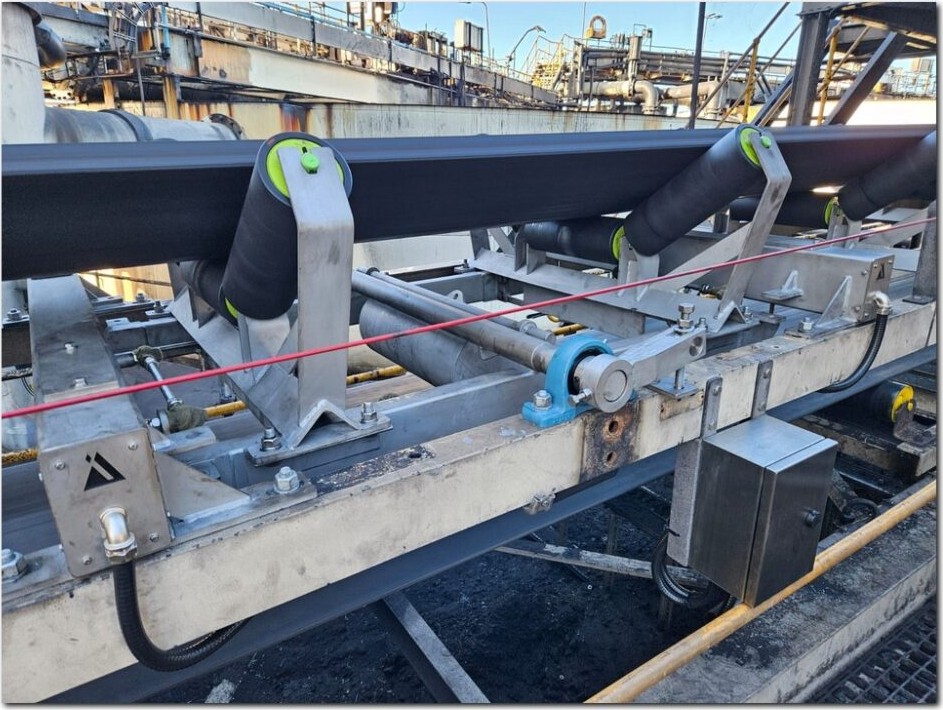
A heavy roller chain of known mass per unit length is draped across the weigh idlers and sits on top of the conveyor belt. The chain is tethered at each end and remains in a fixed position while the conveyor belt moves beneath it — this means the load is applied to the weigh zone in a way that can replicate some of the belt tension variations caused by tracking and idler alignment that a stationary load on the weigh frame cannot.
What it’s good for: Of the simulated methods, chains can replicate some material loading conditions more closely than a static load. They are a recognised calibration method used across the industry. On a well-installed belt weigher on a stable conveyor, the practical difference in result between chain calibration and static weights is sometimes minimal — though there are specific applications where chain calibration makes clear sense over static weights. Chains can also provide a useful reference point across multiple weighers on the same site and tracked over time, giving a consistent basis for comparison that supports longer-term calibration trend analysis.
Its limitations: In a standard chain setup, the belt must be stopped to apply and remove the chain, and exact placement is critical — you’ll need more than one person to guide it into place safely. That combination of belt stoppage and crew requirements makes this a time-intensive exercise. Linearity testing can be difficult with most chain setups. Chains are also a meaningful capital cost and require ongoing storage and maintenance.
A note on motorised chain reel systems: Some installations use permanently mounted chain reels with their own drive motor, allowing the chain to be deployed and retrieved while the belt keeps running. This removes the need to stop and restart the conveyor, making chain calibration significantly faster and more practical as a routine check. That said, these systems are a substantial investment, introduce another item requiring regular maintenance, and need their own due diligence from an OH&S perspective — particularly around safe operation and energy isolation procedures. They’re worth knowing about, but the decision to install one warrants careful evaluation for your specific site.
Material Calibration (In-Situ Test)
Actual material is run over the belt weigher and simultaneously weighed by an independent, recently verified reference scale — a weighbridge, weigh bin, or certified reference scale.
What it’s good for: Material calibration replicates actual operating conditions in every respect: real material, real belt loading, real speed variations, real environmental conditions. It is the only method that gives you a truly traceable result and the only method that some trade custody and fiscal applications will accept as definitive.
Its limitations: It requires a verified reference scale, it takes time to set up and run properly, and it needs enough material and belt running time to produce a statistically valid result. The quality of the result depends heavily on how the test is run — test duration, number of belt circuits, and ensuring the integrator has accumulated enough counts to average out belt-related variations.
For operations where accuracy is critical — high-value commodities, royalty measurement, trade or fiscal applications — material calibration should be a core part of the calibration schedule.
Zero, Span, and Belt Speed: The Three Things You’re Always Checking
Regardless of which method you use, every calibration is ultimately verifying three parameters:
Zero is what the scale reads when the belt is running empty. It’s affected by belt weight, tension, tracking, material buildup on weighed components, temperature-related structural changes, and environmental factors like wind. Zero errors accumulate constantly — even when no material is running — which is why zero drift tends to be the more frequent issue in day-to-day operation.
Span is the scaling factor that converts the load cell output and belt speed into a flow rate. Span errors mean your totals are systematically high or low by a percentage. They’re typically caused by mechanical wear (idlers, speed sensor rollers), material accumulating on the speed sensor, shifts in conveyor structure or idler alignment, or problems with the simulated load used during calibration. Span tends to drift more slowly than zero, but the effects are proportionally larger.
Belt speed accuracy is the third leg of the stool and one that’s easy to overlook. Because flow rate is calculated by multiplying the weight on the belt by belt speed, any error in speed measurement carries directly through to your totals — a 2% speed error means a 2% error in every tonne recorded, regardless of how well the load cells are calibrated. Speed is typically measured by a sensor roller riding against the belt or a tachometer on a return idler. Common issues include slippage between the roller and belt, material buildup changing the effective roller diameter, and mechanical wear. Verifying that the measured belt speed matches actual belt speed — ideally with an independent reference — should be part of any thorough calibration exercise, not an afterthought.
A good calibration routine addresses all three.
How Often Should You Calibrate?
There’s no universal answer — it depends on the accuracy your operation requires and the conditions the equipment operates in. A useful starting point is reviewing the trend from your previous calibration records — how much has zero or span shifted between services, and in which direction? That history, combined with a simple risk assessment of the likelihood and consequence of a measurement error at different service intervals, gives you a much more defensible calibration schedule than a generic rule of thumb.
As a general guide:
High-accuracy applications (trade, fiscal, royalty, or wherever measurement underpins payment):
- Check zero and span before and after each significant weighment period
- Material calibration whenever changes are made to the conveyor or instrumentation, and at a minimum every six months
- Document everything
Moderate-accuracy applications (process control, blending, inventory tracking):
- Zero checks frequently — ideally using automatic zero tracking where conditions allow
- Span checks monthly using simulated methods, material calibration at least annually
- Investigate any anomalies promptly rather than adjusting and moving on
Lower-accuracy applications (approximate throughput monitoring):
- Simulated calibration on a regular quarterly schedule, or whenever changes occur to the belt line
The factors that should push you toward more frequent calibration include: a harsh or dusty environment, a belt prone to tracking issues or tension changes, a high-value commodity, or a history of unexplained discrepancies. If you’re unsure where your operation sits, talking through your specific application and service history with a specialist is a practical way to land on an interval that’s both appropriate and defensible.
What Affects Accuracy Between Calibrations?
Even a well-calibrated scale can develop errors if conditions change. The main culprits are:
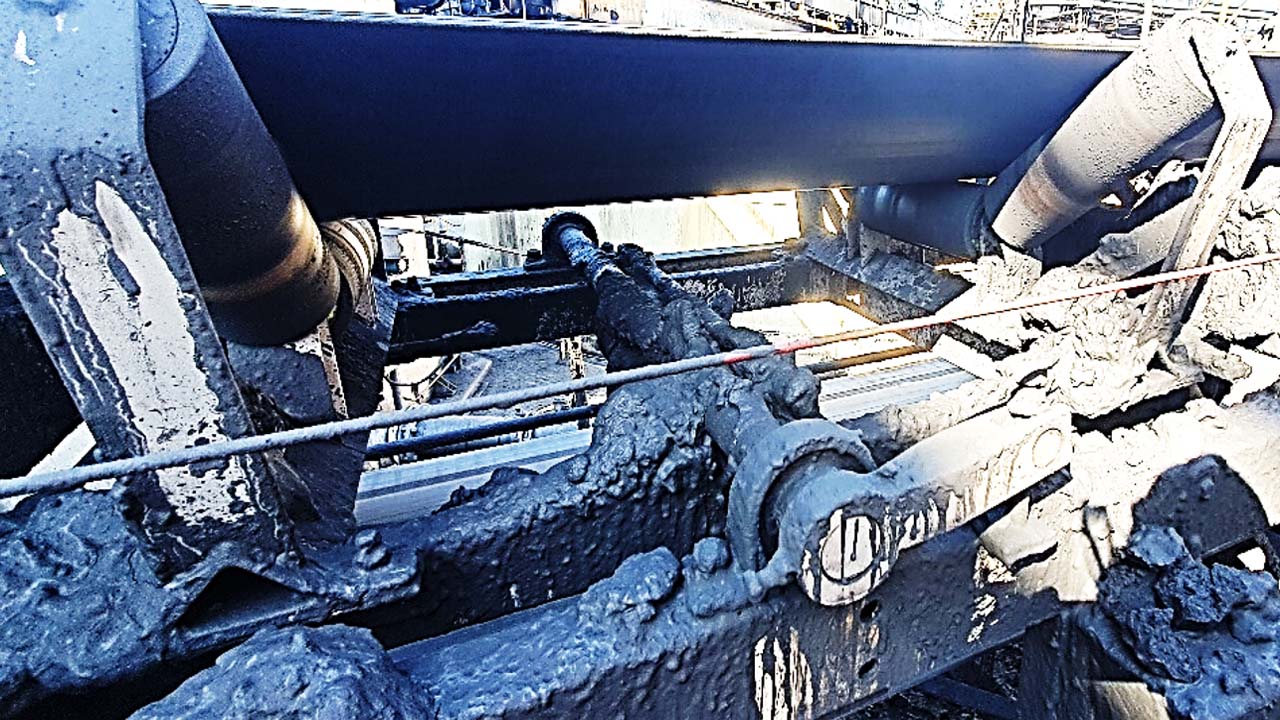
Environmental: Material accumulation on weighed components is a common cause of zero error. Belt condition — wear, stretch, temperature effects on tension — also plays a significant role.
Mechanical: Any change to conveyor structure, idler alignment, or belt tension will affect the calibration. This includes maintenance work that seems unrelated to the scale — changing idlers adjacent to the weigh frame, adjusting a mechanical take-up, or repairs to the conveyor structure.
Speed measurement: The speed sensor is often overlooked, but material accumulation on the speed sensor roller is a common cause of span errors. Keep it clean.
The best protection against unexpected errors is a combination of consistent housekeeping, good maintenance records, and regular calibration checks with a clear documented trend over time.
The Role of Pre-Calibration Warm-Up
This is worth highlighting because it’s often skipped in the interest of getting a job done quickly: the entire measurement system needs adequate time to stabilise before any calibration is performed.
The load cells, electronics, and conveyor structure all respond to temperature. Running calibrations on cold equipment — particularly early in a shift or after a shutdown — will give you readings that don’t represent the operating condition of the scale. The belt should be running under normal operating conditions for a meaningful period before calibration commences.
This isn’t just good practice — calibrating equipment that hasn’t reached stable operating temperature can produce results that don’t represent how the scale performs under normal conditions.
Making Sense of Your Calibration Records
A single calibration result tells you where the scale is today. A series of calibration records over time tells you something far more useful: the trend.
Is the zero drifting consistently in one direction? That suggests material buildup or a mechanical issue. Is span drifting gradually? Check the speed sensor and idler condition. Are results jumping around unpredictably? Look at environmental conditions and belt tension stability.
Calibration records that are treated as a trend document — not just a compliance checkbox — are one of the most powerful diagnostic tools available for belt weigher maintenance.
These Methods Apply to Any Belt Weigher Brand
The calibration principles described in this article are universal. Whether your site is running equipment from a long-established global manufacturer or a more recent installation, the fundamentals of zero, span, and belt speed verification apply equally across all platforms.
Belt weighers from manufacturers including Schenck Process, Thermo Ramsey, Control Systems Technology (CST), Siemens, Tecweigh, Webtech, EMC, Process Automation (Real Time Instruments), and others all operate on the same underlying measurement principles — and all are subject to the same error mechanisms and calibration requirements described here.
The interface for performing a calibration will vary between controllers and integrators — menu structures, parameter names, and calibration workflows differ from brand to brand and model to model. But the physical process being performed, and the discipline required to do it properly, remains consistent regardless of what’s written on the front of the enclosure.
If you’re unsure how a specific calibration method applies to your installed equipment, or you’re working with older or less-documented instrumentation, that’s exactly the kind of question we’re set up to help with.
Want to Talk Through Your Calibration Program?
Calibration isn’t one-size-fits-all, and the right program depends on your application, the equipment installed, and what level of accuracy your operation actually requires.
We work with operations across a wide range of industries — mining, quarrying, bulk materials handling, grain, fertiliser, sugar, cement, food processing, explosives, recycling, and more — and we’ve seen firsthand how much a well-structured calibration program improves measurement confidence (and how much a poorly managed one costs in the long run).
If you would like to talk through your specific situation — whether that is a calibration giving you unexpected results, a new installation you want to get right from day one, or a review of your existing calibration schedule — we are happy to have that conversation.