
A false trip is the detector stopping the belt, or alarming, when there’s no tramp metal worth catching. Nuisance trips cost production, and they teach operators to ignore or bypass the detector, which is worse. Most false trips have a physical cause you can find, and the pattern of the trips usually tells you where to look.
Work on or near a conveyor, or inside an electrical enclosure, needs isolation under your site’s procedures and trained, authorised people. If that’s not you, stop and call us on 1300 101 666.
Is it really a false trip?
Check first. The detector may be doing its job: a small piece of wear liner, a fastener or a broken tooth tip in the material all count. Look at what was on the belt at the trip point, using the marker if one is fitted, before you decide the detector is wrong.
What does the pattern of trips tell you?
- Trips at a regular interval point at the belt: a mechanical splice, belt clips or a repair with metal in it passing the coil once per belt revolution. Time the gap between trips against the belt’s lap time.
- Trips when a machine starts point at electrical interference: a variable speed drive, a big motor or welding nearby, or power cables run too close to the detector or its cabling.
- Trips as the belt loads up, or on a rough day point at movement: steel near the coil shifting, a loose idler, a frame that isn’t rigid.
- Trips that started after a change point at the change: a new belt, new idlers, a sensitivity setting, a different product, or steel work near the coil.
What causes false trips?
Belt splices, clips and repairs
Metal fasteners and mechanical splices are metal moving through the coil, so the detector sees them every lap. Steel-cord belts are the same problem across the whole belt. The detector has to be chosen and set up for the belt it’s on, and a belt change can mean a setup change.
Steel moving near the coil
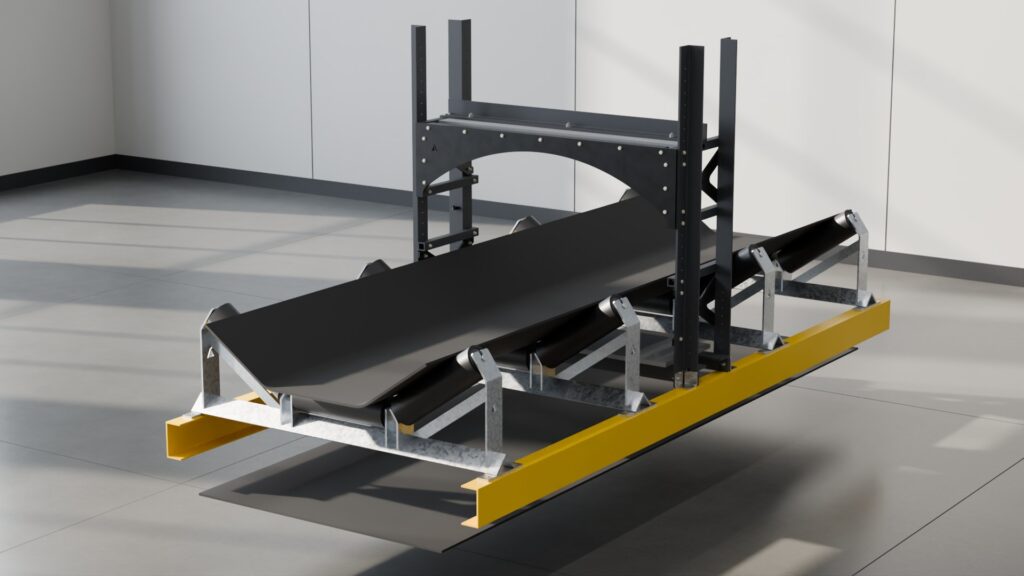
Steel that stays still is tuned out at setup. Steel that moves isn’t: an idler set that rattles, a loose guard, a walkway plate, or a chute section flexing under load. Our own tramp metal detector uses a non-metallic FRP frame around two coils, so there’s no steel in the detector frame itself to move or vibrate.
Electrical interference
Drives, large motors, welders and radios all produce fields the coil can pick up. Keep power cables away from the detector and its cabling, earth it properly, and note what was running when the trips happened.
Build-up and wet material
Some materials, wet or mineralised ones especially, give a signal of their own, and build-up on the belt or around the coil changes what the detector sees. Keep the area clean and check the sensitivity suits the product.
Sensitivity and setup
Set too sensitive, a detector trips on things that don’t matter. Set it for the smallest piece your crusher or downstream gear actually needs protecting from, not the finest the detector can manage. Protected settings should only be changed by trained people, and every change recorded.
What do we check on site?
We start with the trip history and its pattern, then the belt and splices, the detector mounting and the steel around the coil, cabling and earthing, nearby drives, and the setup. Then we test it with a known metal test piece at its working sensitivity, so you know it still catches what matters once the nuisance trips are gone. We service our own detectors and other brands, including Oretronic; see conveyor metal detector service. Not sure a detector is the right tool? See tramp metal detector vs magnetic separator.
Should we just turn the sensitivity down?
Not as a first step. Turn it down far enough and the trips stop, but so does the protection. Find the cause, fix it, then set the sensitivity to the smallest item you need to catch. And never bypass the detector or its interlocks to keep production running.
Frequently asked questions
Why does our metal detector trip at the same point every lap?
Almost always something in the belt: a mechanical splice, belt clips or a metal repair. Time the trips against the belt’s lap time to confirm it.
Can a VSD cause metal detector false trips?
Yes. Drives and large motors are a common source of interference, especially when power cables run close to the detector or its cabling.
Will a new belt stop the false trips?
Only if the old belt was the cause. A new belt with different splices or construction can also need the detector set up again.