
Belt weigher load cells convert force from the weigh assembly into an electrical signal. The integrator uses that signal and belt speed to calculate flow rate and total tonnes. When a weightometer reads incorrectly, the cause may be the load cell, but it may also be the weigh frame, belt behaviour, cable, junction box or configuration.
This guide explains the checks behind a diagnosis. For supply and identification, see belt weigher load cells. For the wider system, see how a belt weigher works.
What does mV/V mean?
Many belt weigher load cells use strain gauges arranged in an electrical bridge. Rated output in millivolts per volt describes the nominal signal change at rated load for each volt of excitation. It is a sensor specification, not the complete belt scale’s accuracy.
Example only: a nominal 2 mV/V cell supplied with 10 V produces about 20 mV of signal change from zero to rated load. Installed dead load, zero balance, force direction and the frame’s load path matter when interpreting a real measurement. Do not expect a loaded assembly to read the cell’s unloaded zero.
Which load cell types can be used?
- Compression cells: measure compressive force through the intended mounting arrangement.
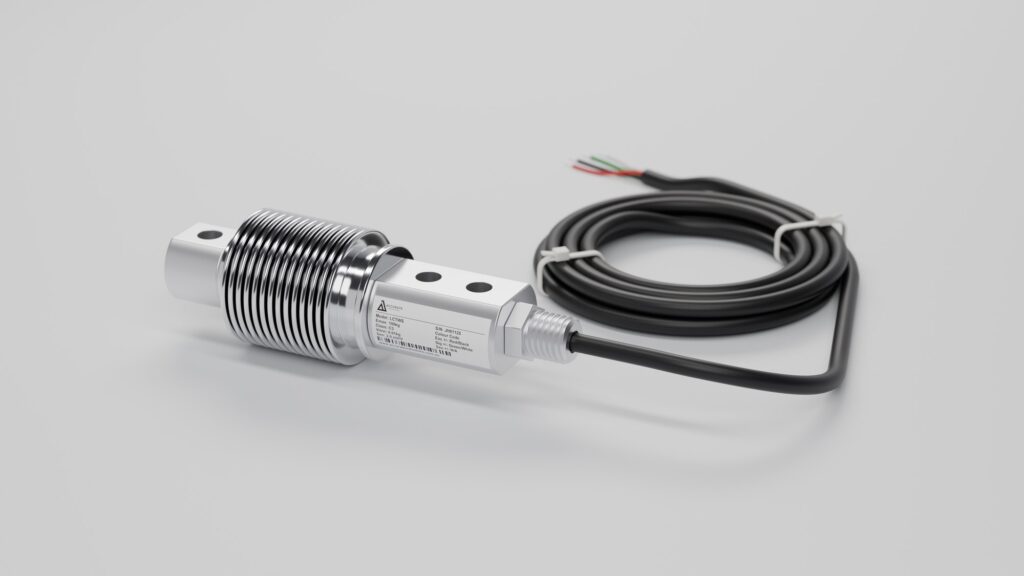
- Shear or bending beams: use a beam-shaped sensing element; loading points and mounting details depend on the model.
- Single-point cells: are designed to tolerate specified off-centre loading in a suitable platform arrangement, within stated limits. They do not measure equally under any load at any location.
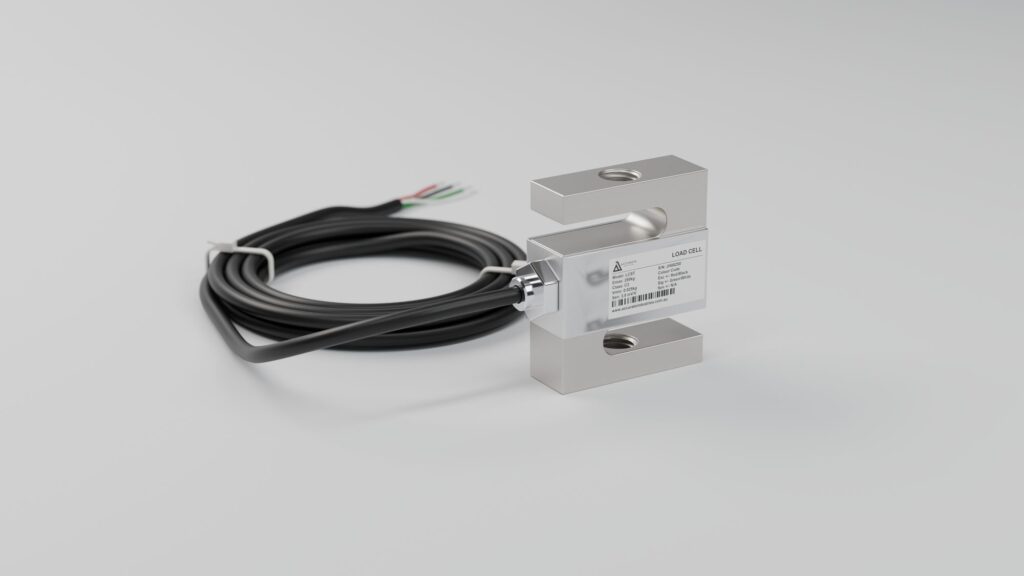
- S-type cells: can be designed for tension, compression or both. The installation determines the required force direction and fittings.
Shape alone does not establish capacity, compatibility or suitability. Identify the full model, capacity, rated output, mounting arrangement and environment before selecting a replacement.
What is the difference between four-wire and six-wire connections?
A typical four-wire analogue cell has excitation and signal pairs. A six-wire arrangement adds a sense pair so compatible electronics can account for the excitation voltage at the sense connection point. The benefit depends on correct wiring and where sensing occurs; it does not make every cable effect disappear.
Cable modifications, extensions, junction boxes and sense links must follow the equipment documentation. Do not identify wire functions by colour alone: manufacturers can use different conventions. Confirm compatibility before connecting a replacement cell or altering a cable.
What does a technician check?
Testing requires an appropriate mechanical and electrical work plan. Safely supporting or unloading a weigh assembly is a separate task from simply stopping the belt. Do not disconnect load-bearing components or conduct live electrical tests unless trained, authorised and following the applicable procedures.
- Mechanical condition: check loading direction, supports, restraints, damage, build-up and unintended contact with surrounding equipment.
- Supply and signal: compare the measured excitation and response with the model specification and known loading conditions.
- Bridge resistance: compare input and output resistance separately with their respective specifications. The two values need not be equal or within a few ohms of each other.
- Insulation: use only the manufacturer-approved procedure and test voltage, with sensitive electronics disconnected as required. There is no universal insulation-test voltage suitable for every load cell.
- Repeatability and load distribution: assess response to an appropriate reference. Different installed cell readings are not automatically faults; load paths and dead load may differ.
A multimeter can assist with preliminary checks, but it cannot prove the complete accuracy or condition of a load cell. A normal resistance reading does not rule out mechanical damage, moisture effects or a fault under load. Manufacturer test methods and suitable reference equipment matter.
What can cause failure or unstable readings?
Possible causes include overload or shock, corrosion, moisture entry, damaged cables, electrical surges, poor connections and inappropriate mounting. Temperature or time-dependent effects must be judged against the model’s specifications; a change with temperature or a little creep is not by itself proof that a cell has reached the end of its life.
Check the signal path before buying parts. Water in a junction box can resemble a sensor problem, while a healthy cell cannot correct a fouled weigh frame. Record the symptom, when it occurs and any recent maintenance or weather exposure.
Can just one load cell be replaced?
Sometimes. The replacement must suit the capacity, sensitivity, electrical characteristics, mounting and load-sharing arrangement. Matching the nominal capacity alone is not enough. Individual-channel adjustment or corner tests are appropriate only where the design supports them.
After repair or replacement, confirm configuration and carry out the required calibration and verification checks on the complete installation. Accurate Industries will assess the fault, repair where practical and recommend suitable replacement equipment or an upgrade where justified.
Frequently asked questions
Can I use a cell with the same kilogram rating?
Not on that information alone. Confirm the full mechanical and electrical specification, including how it works with other cells and the integrator.
Is a wandering zero always a damaged load cell?
No. Inspect the mechanics, belt behaviour, wiring, junction boxes and configuration as well as the sensor.
Can you supply load cells outside Australia?
We welcome equipment enquiries worldwide. Send the label and installation details so we can confirm a suitable option and delivery arrangements.
Need a manual for your equipment?
Talk to us about manuals for your equipment. Send the make, model, serial number and software version (a photo of the label is fine) and we’ll help you find the right document.