
Accurate Industries has prepared this IMARC 2026 guide for mining and quarrying teams assessing belt weighers, weightometers and conveyor measurement equipment. Start with the decision you need to make: measuring tonnes, checking belt loading, detecting tramp metal, or getting dependable information into your plant controls.
By Accurate Industries | Event information checked 27 September 2026
IMARC 2026 takes place at ICC Sydney on 27–29 October. This guide identifies exhibitors with relevant capabilities and suggests questions to help you compare their answers. It reflects our perspective as a supplier and service provider in weighing and conveyor measurement and is not an official IMARC publication.

27–29 October 2026 | ICC Sydney
Official event information
Which exhibitors are relevant?
The following shortlist combines companies working directly in conveyor measurement and protection with suppliers involved in the surrounding plant. The fit descriptions are our assessment of their published capabilities, not a ranking of product performance.
Stand references come from IMARC’s current directory. A company listing does not confirm that a particular product or specialist will be available on its stand. Check the latest directory and arrange technical discussions before travelling.
| Exhibitor | Listed stand | Relevant capability | A useful question to take with you |
|---|---|---|---|
| Hexagon | Q21 | Mining measurement and automation. Its acquisition of indurad connects it to radar measurement of conveyor volume, speed and alignment. | Can you arrange a discussion with an indurad specialist about combining radar measurements with our existing belt weigher? |
| LASE | N01 – I | Industrial laser measurement, including the LaseBVC conveyor volume system. | What does the system measure directly, and what density information is used if the output is expressed as mass? |
| LONGi Magnet | R19 | Magnetic separators and metal detectors for mining and recycling. | Which contaminants can the proposed arrangement detect or remove at our belt speed and material burden depth? |
| ifm efector | N01 – M | Sensors, process instrumentation and IO-Link automation. | How would the selected sensors report a fault, lost signal or maintenance requirement to our existing control system? |
| KOCH Solutions Australia | V31 | Bulk materials handling equipment and systems. | Where should measurement and protection equipment sit in the conveyor design, and what access will it need for maintenance? |
| Metso | G21 | Equipment and services for aggregates and minerals processing. | Where would better throughput measurement help us understand a restriction or compare performance across the plant? |
| FLS | Q17 | Mineral processing equipment, services and plant optimisation. | Which process decisions would use the flow measurement, and what operating range and verification would those decisions require? |
| Jenike & Johanson | B12 | Engineering for bulk solids flow, storage, conveying and processing. | Could the feeding or material-flow arrangement be contributing to the inconsistent results we are investigating? |
Hexagon’s ownership of indurad is documented in its acquisition announcement. The product references above are supported by the manufacturers’ iBelt information and LaseBVC information. Their inclusion is not a promise of a live demonstration at IMARC.
Accurate Industries partners with Hexagon across our radar offering and is an Australian systems integrator for indurad, part of Hexagon. We supply, install and commission the indurad iBelt range locally. Our partnership announcement explains this connection.
From the field: conveyor radar at a Sydney recycling facility
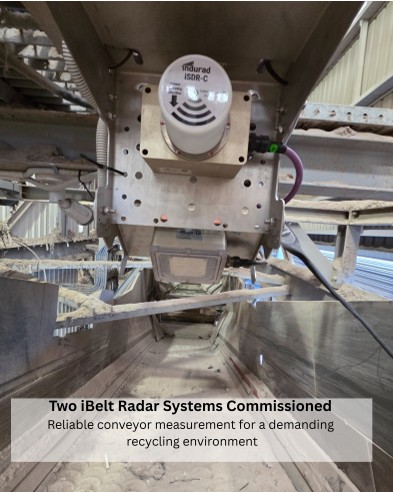
Accurate Industries installed and commissioned two indurad iBelt radar systems at a recycling facility in Sydney. The conveyor structure made a conventional belt-weigher installation difficult, so the project used radar equipment mounted above the belt.
The installation supplied real-time volume-flow data to the plant control system and contactless belt-speed measurement. Hexagon Mining also shared the project, acknowledging our work as its partner.
This provides a useful question for IMARC: which measurement suits the available space and the information the plant needs? This project measured volume and speed. If your application requires tonnes, ask how mass would be determined and checked.
Read our Sydney installation update.
Six questions that make a supplier discussion useful
1. Are we comparing mass, volume or another measurement?
A belt weigher combines belt loading and speed to calculate mass flow and accumulated tonnage. A conveyor scanner may measure the material profile and volume flow. If a volume measurement is converted to mass, the density used in that conversion matters.
Ask the supplier to identify what is measured directly, what is calculated, and which inputs or assumptions can change. Then explain whether your main requirement is tonnage reporting, belt loading, feed control or another task. Two instruments can be useful on the same conveyor while answering different questions.
Accurate Industries’ belt weigher speed sensor guide explains how the speed signal contributes to the reported flow rate and total tonnage.
2. What does the accuracy claim mean on our installation?
Ask for the conditions behind a quoted figure. Is it a component specification, repeatability result, or an installed-system result? What load and speed range does it cover? What installation conditions and exclusions apply?
Agree how performance would be demonstrated before comparing quotations. A useful proposal should explain the acceptance method, the reference measurement and what happens if the agreed result is not achieved.
3. How will we check the measurement after commissioning?
Ask which checks use test weights, chains, material comparisons or other reference methods, and what each check establishes. Request the proposed frequency, records and responsibility for carrying out the work.
Also ask what should trigger another assessment: a belt change, idler work, a changed speed signal or a shift in production results. Our empty-belt reading guide explains why operating symptoms and recent maintenance are useful diagnostic information.
4. How will the result reach the people and systems using it?
Bring the details of your current integrator and control system. Ask which signals and communication options are included, how units and totals are handled, and what users see when a sensor or connection fails.
Have the supplier explain how local readings will be compared with the plant display. Include alarms, time stamps, totaliser resets and any software or licence costs in the discussion. A plausible number on a screen should have a clear origin and a way to check it.
5. What does the proposed protection system actually do?
When discussing metal detectors or magnetic separators, describe the material, likely contaminants, belt speed and burden depth. Ask the supplier to distinguish detection from removal and explain the response to a detection event.
For belt monitoring, ask which conditions the system detects, how it generates an alarm, and how that alarm fits the site’s response procedures. Request evidence relevant to your application rather than assuming every conveyor has the same requirements.
6. Who supports the complete installation?
Ask who is responsible for the mechanical installation, electrical work, configuration, commissioning and ongoing service. Find out which spares are held locally, what access is needed and whether support covers the existing equipment around the new instrument.
For a mixed-brand site, clarify where one supplier’s responsibility ends and another’s begins. Record those boundaries before accepting a proposal.
Accurate Industries provides service, calibration and spares for all major belt-weigher brands. If you plan to retain existing equipment, share its make, model and service history with us so we can assess its ongoing support needs alongside any proposed upgrade.
Take a one-page application brief
You will get more useful answers if every supplier works from the same information:
- The material, operating conditions and problem you need to solve.
- Belt width, speed range and expected minimum, normal and maximum throughput.
- Existing weigh frame, integrator, sensors and plant control system.
- Available installation space, photographs taken under site procedures and maintenance access.
- The decision the measurement will support and how you currently check the result.
Keep a record of each supplier’s assumptions, proposed checks, exclusions and next action. This makes the follow-up comparison more useful than a collection of headline specifications.
Belt weigher service and support from Accurate Industries
Accurate Industries supplies belt weighers and weightometers, radar measurement and conveyor protection equipment, alongside service, calibration and spares for existing installations.
If you are assessing an upgrade before or after IMARC, contact Accurate Industries with your equipment details and the problem you want to solve. We can help assess the weighing and measurement requirements for your application.
Event and exhibitor details can change. Use the organiser’s directory for the latest information.